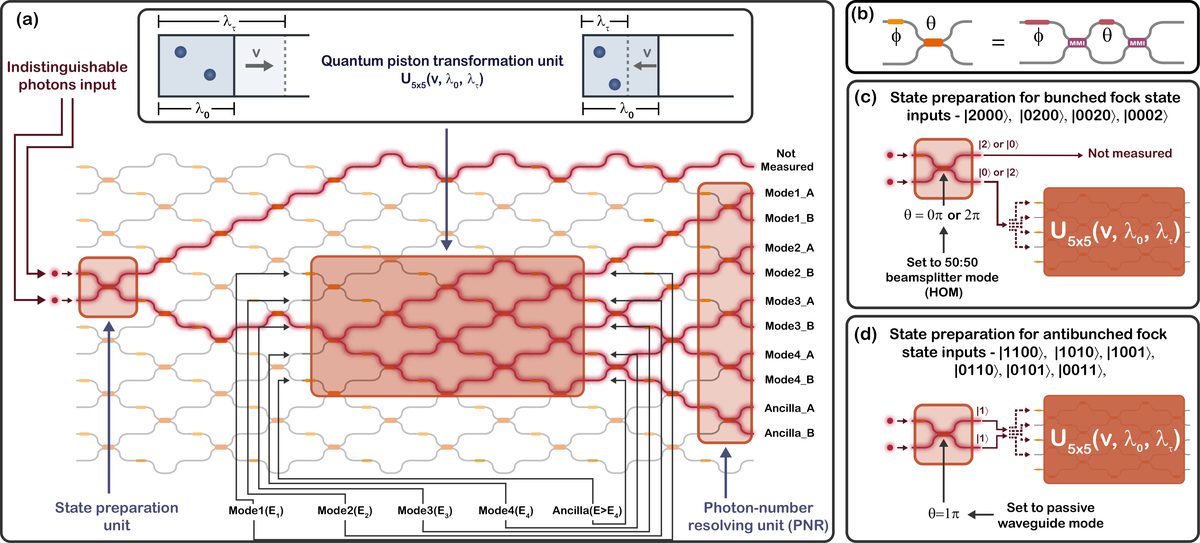
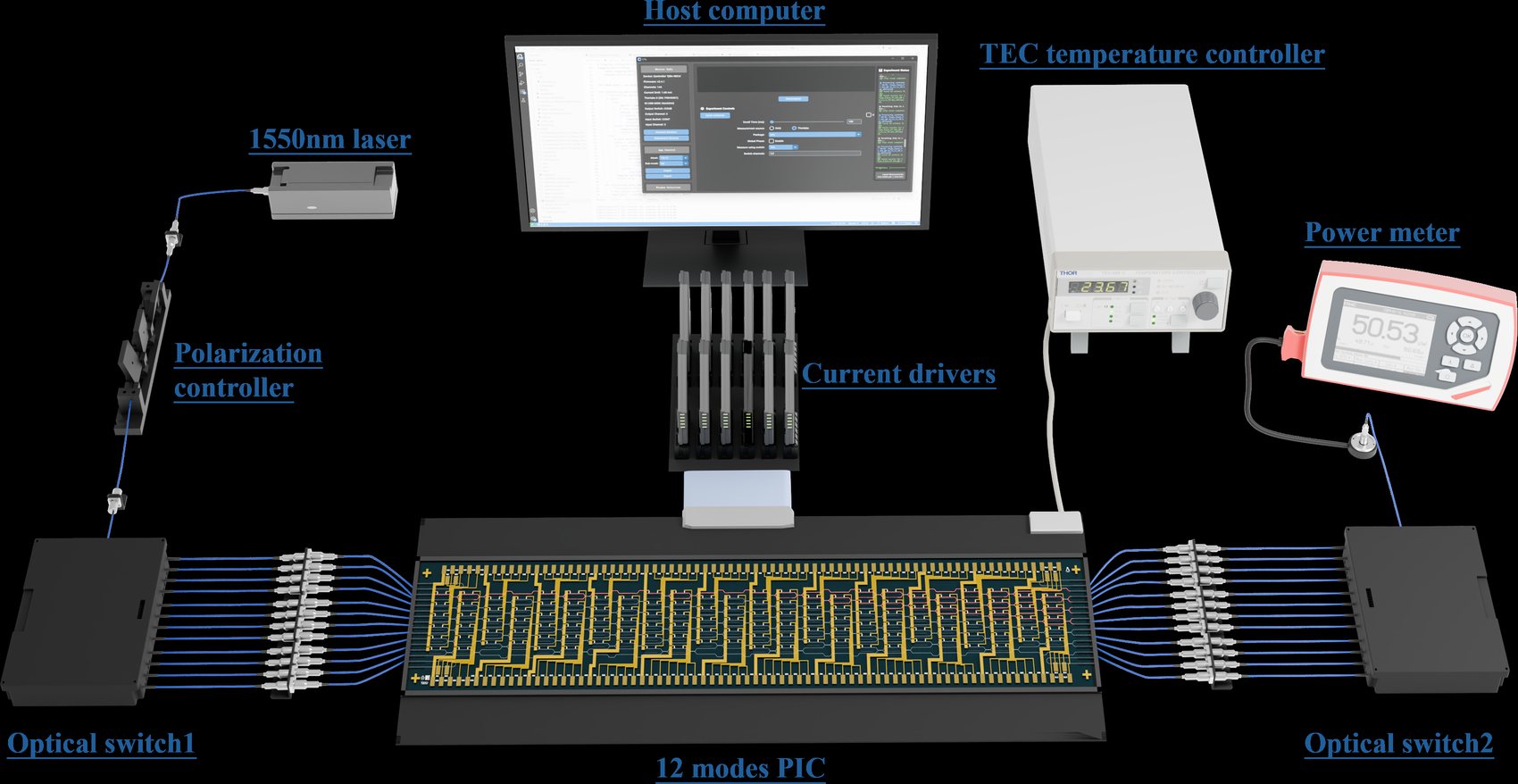
Every capability on this page exists as a published experiment before it becomes a product. This is the science inside the box.
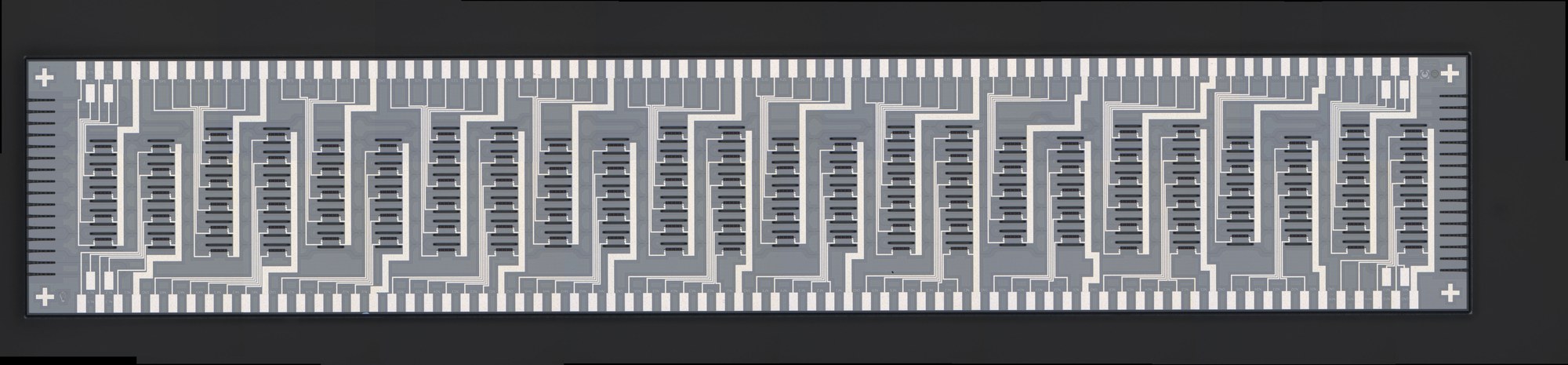
Universal Clements meshes on 220 nm silicon-on-insulator — the most mature, most manufacturable photonics platform there is. Thermo-optic phase shifters, deep-trench thermal isolation, telecom C-band.
Silicon's density and foundry ecosystem make a 12-mode — and soon a 24-mode — universal processor affordable. The honest trade-off is higher propagation loss than specialty platforms; for classical processing, dissipative simulation, and postselected few-photon quantum optics, that trade is decisively worth making — and we will tell you plainly when it is not.
No fabricated mesh matches its ideal diagram, and sequential calibration fails outright when a single element does. The Noor Twin is a physics-informed model of the whole mesh, trained on your specific device; programming becomes a global optimization through it, redistributing control across every surviving element.
Published results, on an 8×8 processor:
Most platforms treat dissipation as the enemy. We program with it: exact unitary dilation embeds any lossy or non-Hermitian evolution into a larger unitary the mesh implements natively. This is how our processors realized dissipative topological invariants, exceptional-point physics, and coherent absorption of quantum light.
Four-phase interferometric readout reconstructs complex amplitudes — magnitude and phase, not mere probabilities. The platform measures what other processors can only infer.
The papers behind this →MZIC Studio decomposes the target, the Twin corrects it for your chip's measured reality, Koi dispatches 64 verified currents. Settling in milliseconds, a full compiled configuration in seconds — thousands of programmed matrices per campaign is demonstrated practice, not a roadmap item.
The founding team's published research spans the full quantum photonics stack — a pipeline of capability behind the current product line.
Deterministic integration of quantum emitters; nanowire quantum dots with telecom-band single and entangled photons.
Waveguide-integrated superconducting nanowire detectors with few-picosecond timing — the receiving end of a future integrated system.
Silicon nitride, thin-film lithium niobate, and III–V materials combined on-chip — the toolbox for next-generation Noor processors.
Every claim on this page traces to a peer-reviewed publication or a public preprint from the founding team.
Browse the publications