Products

One stack. Six lines.

Noor‑Q processors

Flagship line

Universal Clements meshes on silicon-on-insulator: any linear-optical transformation, programmed in software. Delivered packaged — fiber-coupled, thermally stabilized — with a trained digital twin.

Noor‑Q 8

The entry point — teaching labs and protocol development.

  • 8×8 universal Clements mesh
  • 28 MZIs · 56 phase shifters

Noor‑Q 12

The flagship — proven across published quantum and non-Hermitian experiments.

  • 12×12 universal Clements mesh
  • 66 MZIs · 264 on-chip elements

Noor‑Q 24 In development

Twice the modes, the same stack. Early-access program open.

  • 24×24 universal Clements mesh
  • 276 MZIs · 552 phase shifters
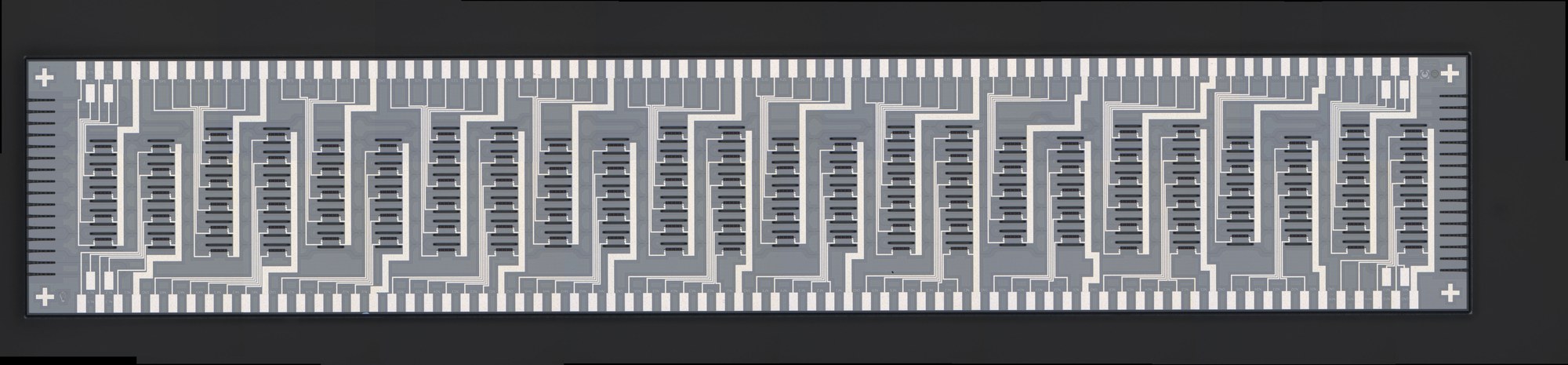
Micrograph of the full Noor-Q 12 die: a 16 mm by 3 mm silicon chip carrying 66 Mach-Zehnder interferometers
The Noor‑Q 12 die — 16 mm × 3 mm of silicon, 66 interferometers, 264 elements.
SpecificationNoor‑Q 8Noor‑Q 12Noor‑Q 24
Mesh8×8 · 28 MZIs12×12 · 66 MZIs24×24 · 276 MZIs
PlatformSilicon-on-insulator · telecom C-band · thermo-optic phase shifters
PackagingFiber-array coupled · TEC-stabilized · deep-trench thermal isolation · Koi-ready
Delivered withTrained Noor Twin · characterization report · MZIC Studio · Noor SDK
StatusShippingShippingEarly access

Dissipative option: engineered loss taps and ancilla channels for native non-unitary programming — on request for any Noor‑Q.
Koi control electronics

Open hardware

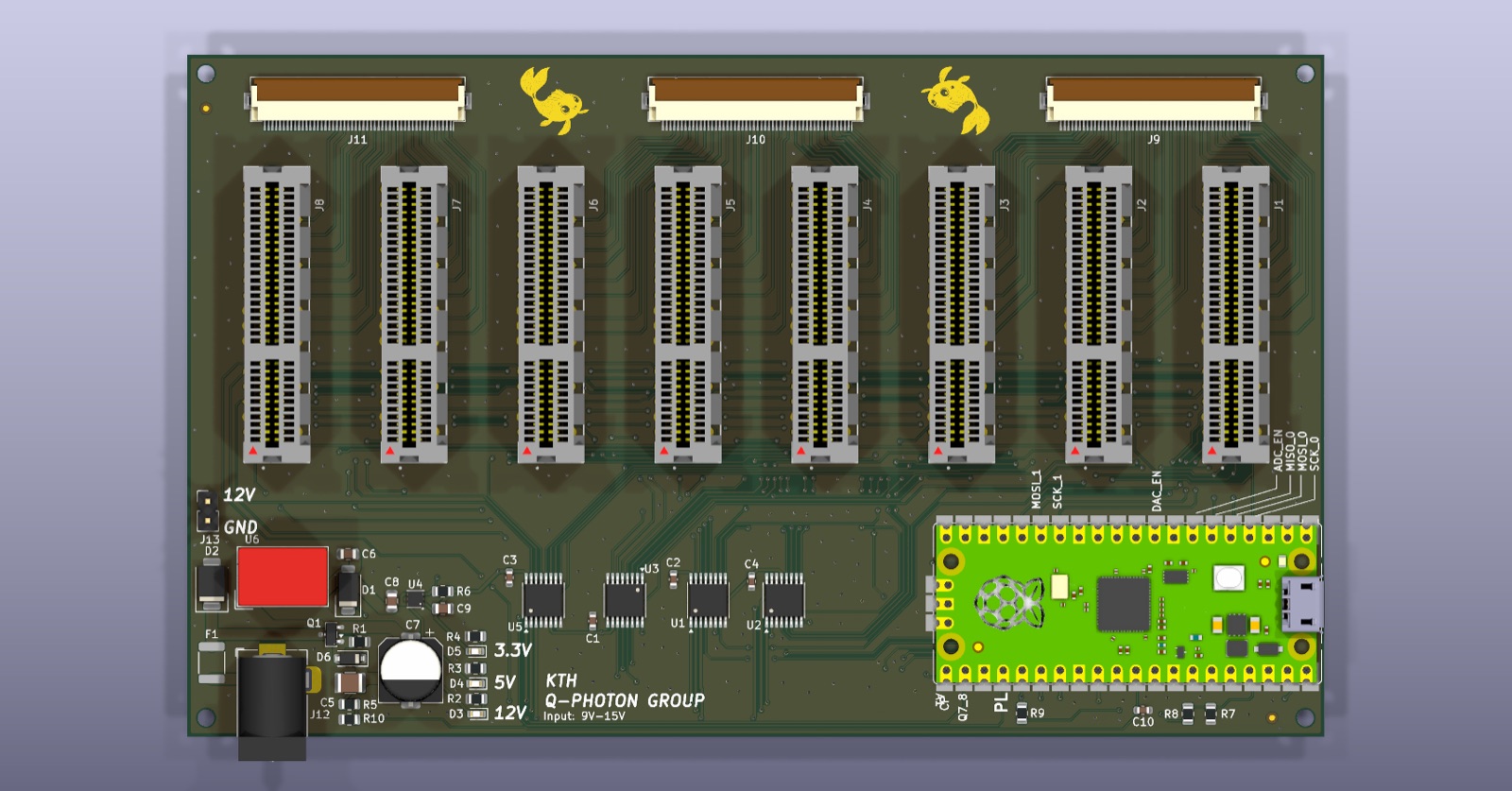
64 channels of precision current with per-channel voltage readback — current, voltage, resistance, and power for every heater on the chip. One controller, eight hot-pluggable cards, a plain-text USB protocol, open firmware and hardware.

  • Koi 8 — single-card evaluation unit
  • Koi 64 — drives a full Noor‑Q 8 or 12
  • Koi 144 — dual-chassis, for large meshes
Render of the Koi 64 motherboard: eight hot-plug daughterboard slots and RP2040 controller
Channels64 (8 × 8), hot-pluggable
Current0–6 mA · 16-bit setting
Readback24-bit ΔΣ · V, I, R, P per channel
Linearity±0.32 µA worst-case (measured)
Full scan< 1 s, all 64 channels

Software

MZIC Studio

Full-mesh control: interactive grid, automated resistance and phase calibration, unitary decomposition, and sequenced experiments with synchronized optical readout.

Included with every Noor‑Q →

Noor SDK

Python toolkit for programmatic control and simulation — the same code our published experiments run on.

  • Unitary & non-unitary compilation
  • Interferometric readout pipelines
  • Multi-photon simulation

The Noor Twin

The differentiator

Noor Twin

A physics-informed model of your specific chip. Compilation becomes a global inverse problem solved through the twin: published fidelity above 0.97 with five phase shifters failed, graceful degradation far beyond.

How it works →

Twin Recovery Service

Hardware ages. Send us your mesh telemetry, get back a re-trained twin and updated compilation tables — fidelity restored in software.

Ask about coverage →

Application kits

Protocols, notebooks, and expected-result datasets — your first figure in days, not months.

Quantum

Quantum Photonics Kit

  • Hong–Ou–Mandel interference protocols
  • Postselected dual-rail CNOT programming
  • W-state & boson-sampling modules
Neuromorphic

Photonic Neural Network Kit

  • The mesh as a programmable linear layer
  • Training-through-the-twin workflow
  • Benchmarks & reference results
Simulation

Non-Hermitian & Topology Kit

  • Exact dilation of non-unitary evolutions
  • Interferometric Zak & Chern readout
  • Exceptional-point protocols
Education

Teaching Edition

  • Noor‑Q 8 + Koi + MZIC Studio
  • Classical light — no cryogenics
  • Course-ready manual, 2-hour experiments

Services

Remote access

Program a hosted Noor‑Q from your desk before committing to hardware.

Custom mesh design

Non-standard topologies and engineered loss, delivered through established foundry runs.

Integration support

Sources to detectors: we help you build the full experiment around the processor.

Configure your instrument.

Tell us your application — we'll propose the configuration.

Request a configuration